Trust shouldn't depend on a server
Most vaults ask you to trust a provider's backend. A browser can now do the cryptography locally, so the server can be optional.
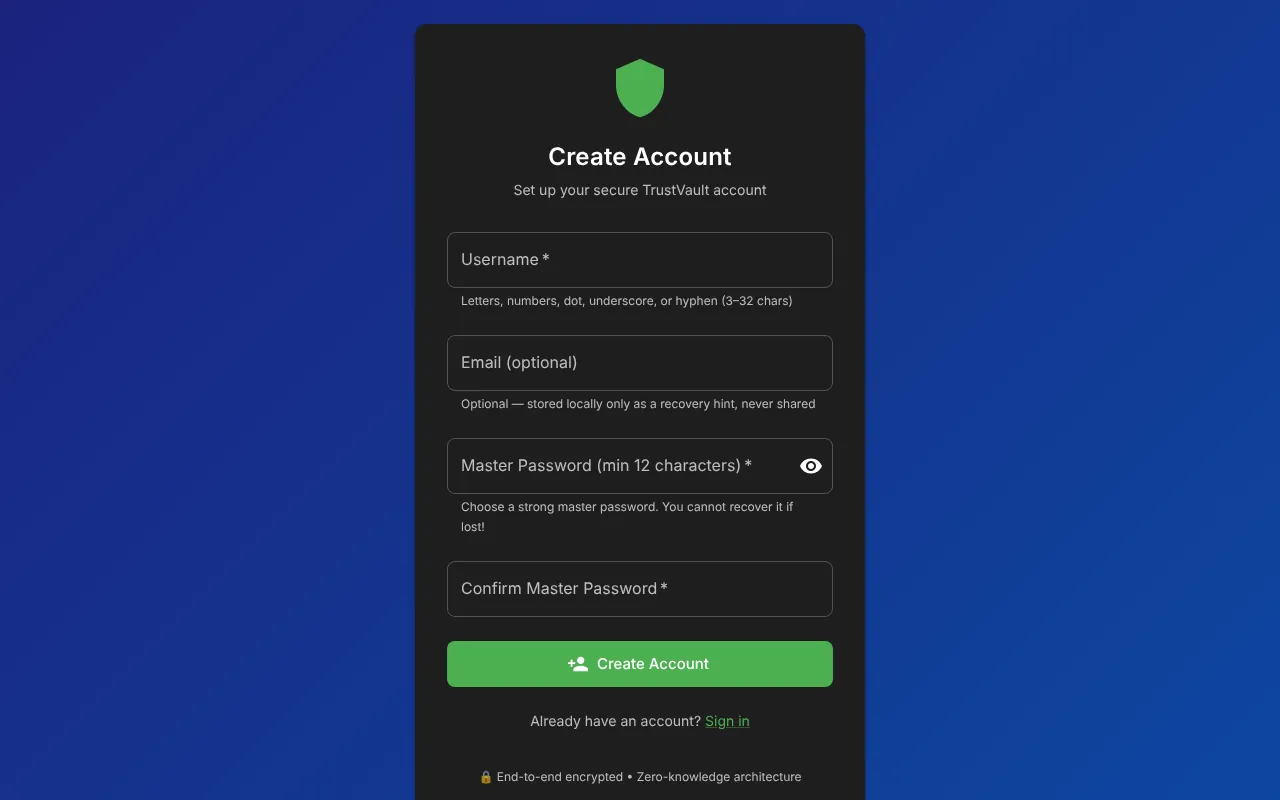
TrustVault is an open-source, offline-first password manager built as a progressive web app, in which every credential is encrypted on the device and stored data alone can never be decrypted. It unlocks with a master password or a passkey through the WebAuthn PRF extension, and explains password risk with AI models that run on the device.
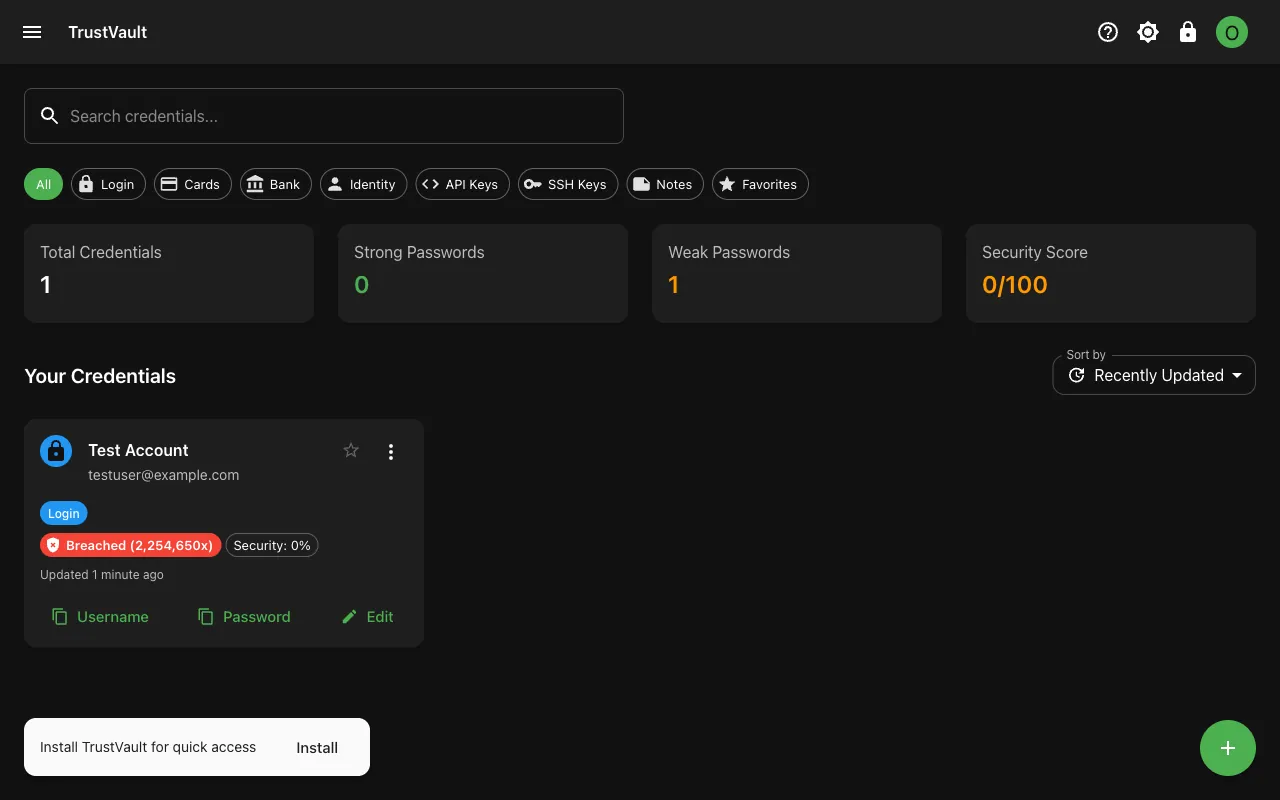
Self-reported by the project; no independent audit yet. Source: Project status ↗
To prove that a web app can meet native-app security expectations without a server that holds your secrets.
Most vaults ask you to trust a provider's backend. A browser can now do the cryptography locally, so the server can be optional.
Passkeys sign in, but they don't encrypt data. The WebAuthn PRF extension can derive a secret from a passkey; few apps use it safely.
Explaining why a password is weak is useful, but sending credentials to a cloud model is unacceptable in a vault.
IndexedDB holds only AES-256-GCM ciphertext, salts and nonces. No stored value can rebuild the vault key.
The vault key is wrapped under both the master password and, optionally, a passkey PRF, so losing a passkey never means losing data.
Session vault keys are non-extractable WebCrypto keys, so even injected script cannot copy their raw bytes.
Master passwords are hashed and the vault key wrapped with memory-hard scrypt (N=131,072, r=8, p=1).
Strength and breach explanations run on Gemini Nano, WebLLM or LiteRT-LM on the device.
Strict hash-based CSP, HSTS, COOP/CORP headers, clipboard auto-clear after 30 seconds and tab-aware auto-lock.
A clean four-layer architecture keeps the cryptography free of UI and storage dependencies.
| Decision | Reason | Call |
|---|---|---|
| Argon2id replaced by scrypt | The WebAssembly Argon2 build conflicted with the strict Content Security Policy. Scrypt from @noble/hashes is memory-hard and pure JavaScript. | Shipped |
| Vault key re-wrapped with scrypt | Legacy PBKDF2-wrapped vaults are upgraded transparently to scrypt-v1 at unlock, with no user action. | Shipped |
| Always keep a password wrap | Tying data to a passkey alone means a deleted passkey destroys the vault. | Shipped |
| Extract the crypto into a library | The PRF key-wrapping engine became webauthn-prf-zktv, with its own tests and preprint. | Shipped |
| Passkey unlock inside the Android app | PRF does not pass through Android WebView to Credential Manager, so the Capacitor app uses the password scheme. | Not possible yet |
| Cloud AI for password advice | Would send credential metadata off the device. On-device models were chosen instead. | Rejected |
Employers trust skills they can verify. Each claim below links to its place in the skills matrix, and every piece of evidence is public.
See the product artifacts: brief, eval spec, metrics tree, decisions
Last public activity 2 August 2026 · checked 5 November 2026
TrustVault is an open-source, zero-knowledge password manager built as a progressive web app by Ian Pinto. It encrypts every credential on the device with AES-256-GCM, stores only ciphertext in IndexedDB, works offline, and can unlock with a passkey through the WebAuthn PRF extension.
It means that the stored data alone cannot be decrypted. The vault key is wrapped under a key derived either from the master password with memory-hard scrypt or from a passkey PRF output that only the authenticator can produce after biometric or PIN verification. Neither input is ever stored.
During unlock the browser asks the authenticator for a PRF output tied to the passkey. TrustVault derives a wrap key from it with HKDF-SHA256 and uses it to unwrap the AES-256-GCM vault key, which stays in memory as a non-extractable CryptoKey. A password wrap of the same key is always kept, so deleting a passkey never destroys data.
No. Password-strength explanations and breach-impact analysis run on local models (Gemini Nano, WebLLM or LiteRT-LM depending on the device), so no credential data leaves the device. Breach checks use the Have I Been Pwned k-anonymity range API, which sends only a short hash prefix.
Yes. A staging build runs at trust-vault-pwa.vercel.app and the source is on GitHub. Use test data only: it is a personal open-source project, not an audited commercial product.
Feature and security benchmark workstreams added to the test-driven improvement plan in August 2026.
Fix the remaining failing tests and lint findings, and complete a full WCAG 2.1 AA audit.
Invite external security review of the key-wrapping design described in the preprint.
Cited answers over 1,490 SEBI circulars, or an honest abstention.
Proves AI evaluation design · Retrieval (RAG) product design · Trust and compliance by design (India) · Communicating AI quality honestly
Last public activity
Passkey-derived vault key wrapping as an npm library and a research preprint.
Proves Privacy and security architecture · Communicating AI quality honestly
Last public activity
Online lectures into transcripts, slide-linked notes and flashcards, entirely on your Mac.
Proves On-device and local AI · AI evaluation design · AI product strategy and MVP scoping
Last public activity
Search Python code in plain English, then get a one-line explanation of each function.
Proves AI evaluation design · Retrieval (RAG) product design · Communicating AI quality honestly
Last public activity